Editorial Policies
Editorial Policies
- Focus and Scope
- Peer Review Process
- Publication Frequency
- Open Access Policy
- Archiving
- Publication Ethics
- Ethical Approval (Ethical Clearance)
- Policy on the Use of Artificial Intelligence (AI)
- Handling of Publication Ethics Violations
- Screening for Plagiarism
- Author Fees
Focus and Scope
The Journal of Agroindustrial Development and Innovation is a scientific journal that publishes research articles, literature reviews, and case studies related to development and innovation in the field of agroindustry. The journal aims to serve as a platform for the dissemination of scientific knowledge among academics, researchers, practitioners, and students to share research findings and scientific ideas that support the development of agriculture-based industries.
The scope of this journal includes:
1. Development and innovation of agroindustrial products
2. Food processing and agroindustry technologies
3. Production planning and process optimization
4. Quality management and food safety
5. Agroindustry supply chains and logistics
6. Sustainable and environmentally friendly agroindustry
7. Agroindustry innovation and entrepreneurship
Peer Review Process
Every manuscript submitted to the Journal of Agroindustrial Development and Innovation undergoes a peer review process to ensure the academic quality and scientific contribution of published articles. This journal employs a double-blind peer review system, in which the identities of authors and reviewers remain anonymous to one another throughout the review process.
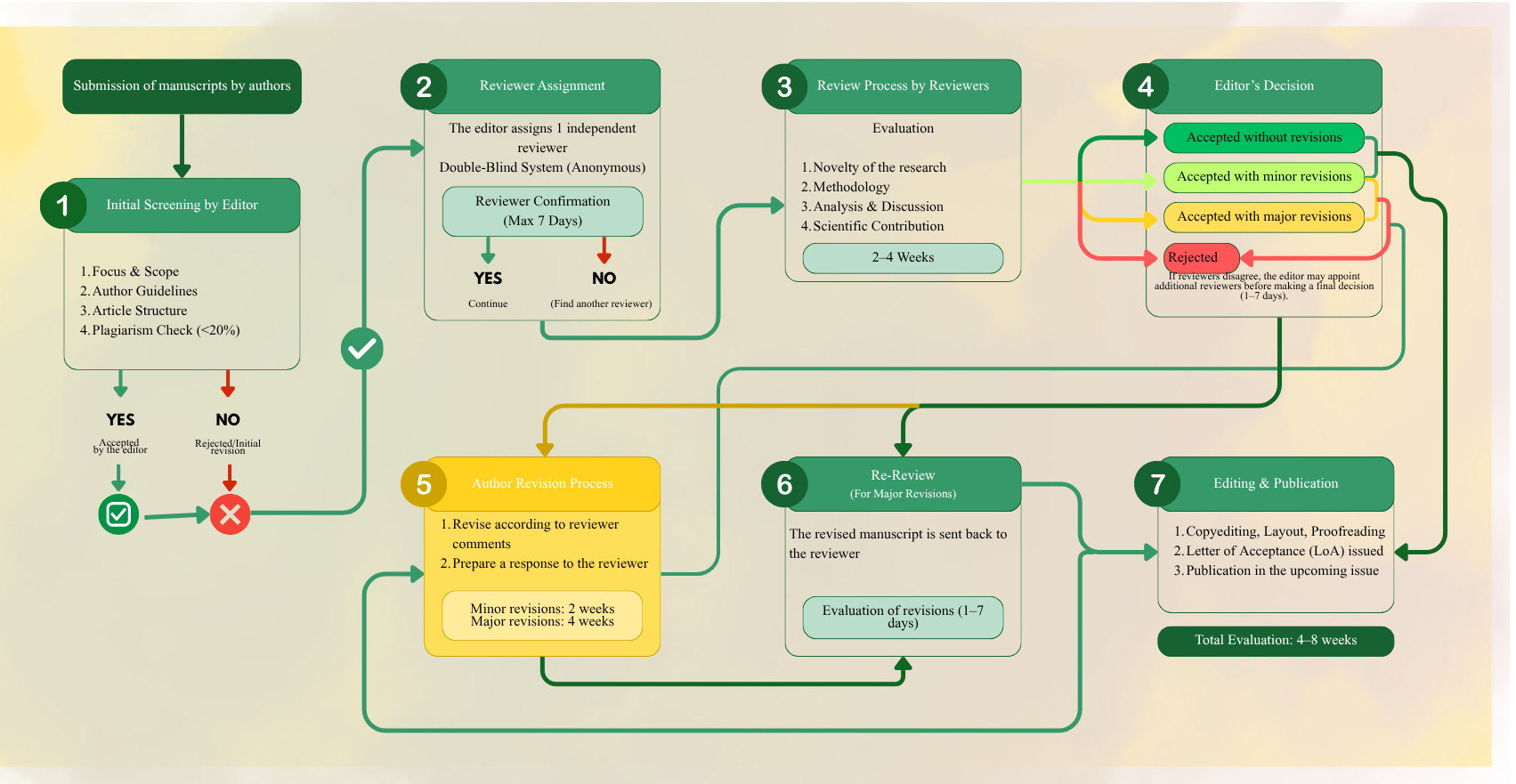
1. Initial Screening by the Editor
After a manuscript is submitted through the journal’s system, the editorial team will conduct an initial screening to ensure that the manuscript:
a) aligns with the journal’s focus and scope
b) follows the article submission guidelines
c) has a complete article structure
At this stage, a similarity check is also performed using plagiarism detection software to ensure the manuscript’s originality. Manuscripts with a similarity rate exceeding 20% will be returned to the author for revision or may be rejected by the editor before proceeding to the review stage within 1–7 days.
Additionally, the editorial team will verify that the writing format, citations, and reference list comply with the current author guidelines. Manuscripts that do not meet these requirements may be returned to the author for revision before being sent to reviewers.
2. Appointment of Reviewers
If a manuscript is deemed to meet the initial requirements, the editor will appoint one independent reviewer with expertise relevant to the research topic. Reviewers are selected from among academics or researchers with expertise in fields relevant to the submitted manuscript.
The review process in the Journal of Agroindustrial Development and Innovation uses a double-blind review system, in which the authors’ identities are not disclosed to the reviewers to ensure objectivity in the evaluation process.
The review invitation and the manuscript to be reviewed are sent simultaneously to the reviewer via the journal’s system. The reviewer is expected to confirm their willingness to conduct the review process within a maximum of 7 days from the date the invitation is received. If the reviewer does not provide confirmation within this timeframe, the editor may appoint another reviewer to continue the manuscript review process.
3. Review Process by the Reviewer
Reviewers will evaluate the manuscript based on several aspects, including:
a) novelty of the research
b) quality of the methodology
c) clarity of the analysis and discussion
d) scientific contribution to the field of agroindustry
Reviewers are given approximately 2–4 weeks to complete the review process and provide recommendations to the editor.
4. Editorial Decision
Based on the reviewers’ evaluations, the editor will make a decision regarding the manuscript, categorizing it as follows:
a) accepted without revisions
b) accepted with minor revisions
c) accepted with major revisions
d) rejected
If there are significant discrepancies among the reviewers, the editor may appoint additional reviewers before making a final decision within 1–7 days.
5. Revision Process by the Author
If the manuscript requires revision, the author is asked to revise the manuscript in accordance with the reviewers’ comments. The revision time allowed is:
a) minor revisions: maximum 2 weeks
b) major revisions: maximum 4 weeks
The author is also asked to include a document responding to the reviewers’ comments that explains the changes made to the manuscript.
6. Re-review
For manuscripts requiring major revisions, the revised manuscript will be sent back to the reviewer for re-evaluation to ensure that the revisions align with the previously provided suggestions and comments. This re-evaluation process typically takes 1–7 days.
If the revisions submitted by the author are deemed adequate and approved by the editor, the manuscript may proceed to the editing and publication preparation stage without undergoing additional review.
7. Editing and Publication
Manuscripts that have been accepted will undergo copyediting, layout editing, and proofreading before being published in the upcoming issue of the journal. At this stage, the author will receive a Letter of Acceptance (LoA) issued by the editor as proof that the article has been accepted for publication in the Journal of Agroindustrial Development and Innovation.
Overall, the manuscript evaluation process until the final decision typically takes about 4–8 weeks, depending on the completeness of the manuscript and the review process.
Publication Frequency
The Journal of Agroindustrial Development and Innovation is published twice a year, in May and October. Each issue of the journal contains five peer-reviewed scientific articles that have undergone a rigorous editorial review and selection process.
Open Access Policy
The Journal of Agroindustrial Development and Innovation adheres to an open access policy, meaning that all articles are freely accessible to readers without subscription fees. This policy aims to enhance the widespread dissemination and exchange of knowledge in the field of agroindustry.
All articles published in this journal are distributed under a Creative Commons Attribution-ShareAlike license, which allows users to read, download, copy, distribute, and reuse the articles while providing appropriate attribution to the authors and the source of publication.
Archiving
Starting from its first publication, the Journal of Agroindustrial Development and Innovation implements a digital archiving policy to ensure the long-term preservation and accessibility of published articles. This journal utilizes the LOCKSS (Lots of Copies Keep Stuff Safe) system to create a distributed archiving system among participating libraries. This system allows libraries to preserve and restore journal content, ensuring permanent access to the journal’s publications. In addition, all published articles are stored and maintained in the journal’s online system to guarantee the availability, security, and long-term accessibility of scholarly content. More...
Publication Ethics
The Journal of Agroindustrial Development and Innovation is committed to maintaining scientific integrity and upholding high standards of publication ethics throughout the article publication process. These ethical guidelines serve as a reference for all parties involved in the publication process, including authors, editors, and reviewers. The principles applied are based on international best practices in scientific publication ethics.
1. Author Responsibilities
a. Research Reporting Standards
Authors must present research results honestly, accurately, and objectively. Articles must clearly describe the research process, methods, and results obtained so that they can be understood and, if necessary, replicated by other researchers. Misrepresentation of data, data manipulation, or the presentation of misleading information constitute unethical conduct in scientific publication.
b. Data Access and Storage
Authors are expected to retain the research data used in the article and be willing to provide such data if required for editorial review or scientific verification. Research data should be retained for a reasonable period of time after the article is published.
c. Originality and Plagiarism
Authors must ensure that the submitted work is original. If using ideas, data, or quotations from others’ works, authors are required to cite sources accurately in accordance with scientific citation guidelines.
d. Dual or Simultaneous Publication
Authors are not permitted to submit the same manuscript or research with the same substance to more than one journal simultaneously. Dual publication or submitting the same article to multiple journals constitutes a violation of publication ethics.
e. Acknowledgment of Sources
Authors must provide proper acknowledgment of the scientific works cited in the research. All sources that contributed to the research must be listed in the reference list.
f. Article Authorship
Authors listed in the article must have made a significant contribution to the research, such as in research design, data collection, analysis, or manuscript writing. All parties who have made significant contributions must be listed as co-authors. The corresponding author is responsible for ensuring that all authors have approved the final version of the article before it is submitted for publication.
g. Disclosure of Conflicts of Interest
Authors must clearly disclose any conflicts of interest that could influence the interpretation or results of the research, including financial support from specific institutions.
h. Errors in Published Articles
If authors discover significant errors or inaccuracies in a published article, they must immediately notify the journal editor and cooperate to make corrections or retract the article if necessary.
i. Research Involving Risks
If the research involves hazardous chemicals, risky procedures, or the use of human or animal subjects, the author must clearly describe safety procedures and ensure that the research has been conducted in accordance with applicable research ethics standards.
2. Editorial Responsibilities
a. Publication Decisions
The editor is responsible for determining which articles are suitable for publication in the journal based on scientific quality, contribution to the field, and relevance to the journal’s focus and scope.
b. Fair Evaluation
The Editor must evaluate each manuscript objectively without considering the author’s personal background, such as race, gender, religion, nationality, or political views.
c. Confidentiality
The Editor and editorial staff must maintain the confidentiality of all information related to submitted manuscripts. Information regarding manuscripts may only be shared with parties involved in the evaluation process, such as reviewers or members of the editorial board.
d. Conflict of Interest
Editors are not permitted to use unpublished information from manuscripts under review for personal research purposes without the written consent of the authors.
e. Management of the Review Process
Editors must ensure that every submitted manuscript undergoes a fair and transparent peer-review process involving reviewers who possess expertise relevant to the research topic.
3. Responsibilities of Reviewers
a. Contribution to Editorial Decisions
Reviewers are responsible for providing scientific evaluations of submitted manuscripts to assist editors in making decisions and to help authors improve the quality of their articles.
b. Timeliness
Reviewers who accept an invitation to review a manuscript are expected to respond in a timely manner. If a reviewer feels they lack the appropriate expertise or cannot complete the review within the specified timeframe, they should immediately inform the editor.
c. Objectivity of Evaluation
The review process must be conducted objectively and professionally. Criticism of the manuscript must be presented constructively and supported by clear arguments.
d. Confidentiality
Manuscripts received for review are confidential documents and must not be shared or discussed with third parties without the editor’s permission.
e. Conflict of Interest
Reviewers must not review a manuscript if they have a conflict of interest with the author, the institution, or the research related to the manuscript.
f. Identification of Relevant References
Reviewers are expected to help identify relevant scholarly works that have not been cited by the authors and to report to the editor if they find substantial similarities with other published works.
Ethical Approval
Research involving human subjects, laboratory animals, or sensitive data must be conducted in accordance with applicable research ethics principles. Authors must ensure that the research has obtained approval from an ethics committee or the appropriate authority, if required.
Information regarding such ethical approval must be clearly stated in the Methods section or in a specific statement within the article.
Policy on the Use of Artificial Intelligence (AI)
Authors are permitted to use artificial intelligence-based tools to assist in the writing process, such as for grammar checking or language editing. However, the use of such technology must not replace the author’s role in generating ideas, conducting analysis, interpreting data, or drawing research conclusions.
The use of AI-based tools must be conducted responsibly, and authors remain fully responsible for the entire content of the submitted article. Artificial intelligence tools cannot be listed as authors of the article.
Handling of Publication Ethics Violations
If indications of a publication ethics violation are found, such as plagiarism, data manipulation, duplicate publication, or undisclosed conflicts of interest, the editorial team will investigate the case.
Based on the evaluation results, the editor may take several actions, including:
a) requesting clarification or revisions from the author,
b) rejecting the manuscript under review,
c) retracting the published article,
d) or taking other actions in accordance with scientific publication ethics standards.
Decisions will be based on the principles of scientific integrity and international publication ethics guidelines recommended by the Committee on Publication Ethics
Plagiarism Screening
Every manuscript submitted to the Journal of Agroindustrial Development and Innovation will undergo a similarity check to ensure the originality of the published scientific work.
The check is conducted using plagiarism detection software, such as Turnitin or iThenticate. Submitted manuscripts must have a maximum similarity rate of 20%.
If the results of the check indicate a similarity rate exceeding this limit, the manuscript may be returned to the author for revision or rejected by the editor before proceeding to the review stage.
This check is conducted as part of the journal’s efforts to maintain academic integrity and ensure that published articles are original scholarly works.
Author Fees
Starting from the journal’s first year of publication, the Journal of Agroindustrial Development and Innovation implements an Article Processing Charge (APC) to support the journal’s management and publication processes.
The applicable article processing charge is as follows:
Article Processing Charge: IDR 000,000 / USD per article.
Special Policy: Articles written by authors from at least three different countries may be published free of charge.
These publication fees are used to support various editorial processes, including:
1. Similarity check,
2. Language editing and improvement of manuscript readability,
3. Proofreading process,
4. As well as layout editing before the article is published.